




DJI Osmo Pocket 4P vs Pocket 4 vs Pocket 3: Which Should You Buy?
DJI’s Pocket series has evolved from a simple vlogging camera into a compact production system for travel, YouTube, interviews, social media and cinematic everyday filmmaking. But the most expensive model is not automatically the best choice for every creator.
The real question is not simply “Which Pocket camera has the best specifications?” It is: “Which Pocket removes the biggest limitation in the way I shoot?”
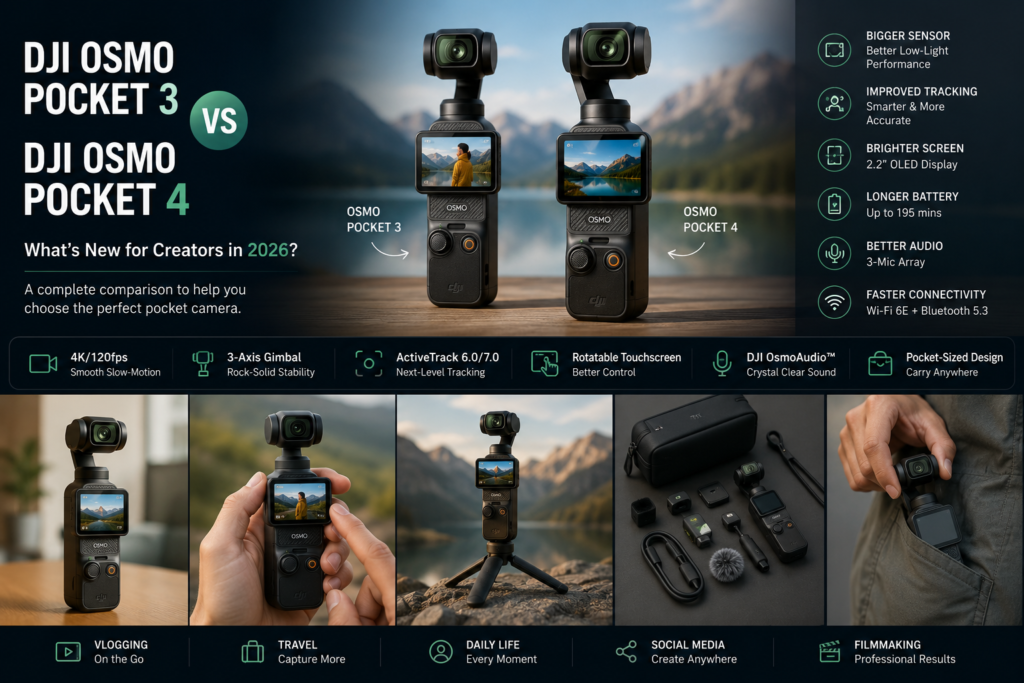
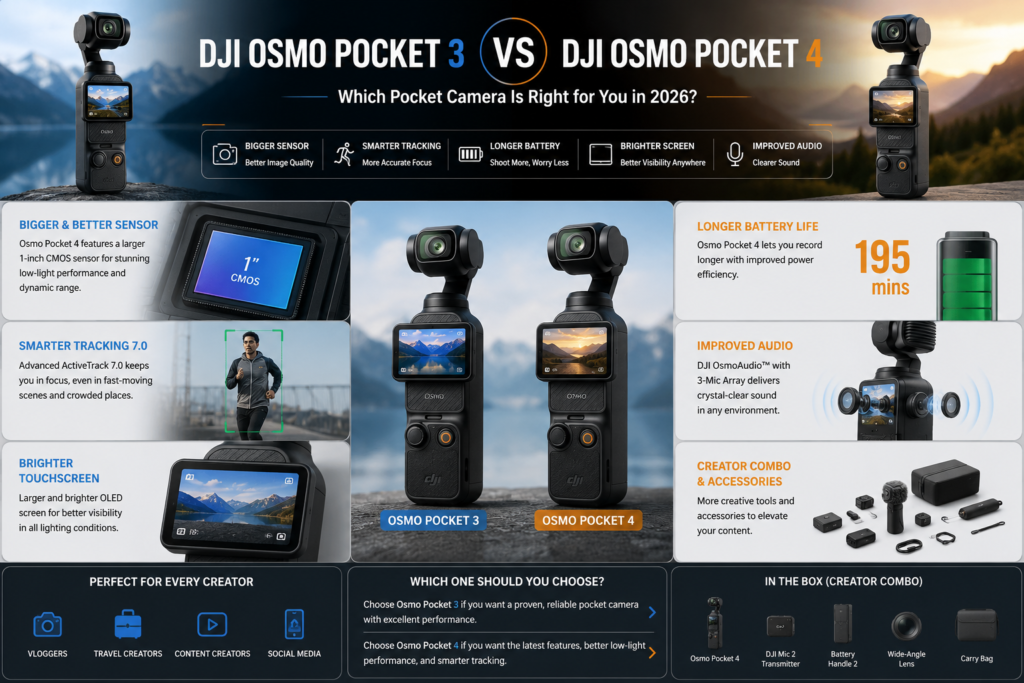
The DJI Osmo Pocket 3 remains a compelling value choice, while the DJI Osmo Pocket 4 is positioned as the strongest all-rounder. The newer DJI Osmo Pocket 4P takes the concept further with a dual-camera system aimed at creators who need more framing flexibility and advanced imaging control.
Ideal when you want excellent image quality and stabilization without paying for the newest features.
The strongest balance of image quality, tracking, high-frame-rate recording and everyday portability.
The choice for creators who can actually benefit from its dual-lens system and advanced imaging workflow.
Pocket 3, Pocket 4 or Pocket 4P?
Think of the three cameras as different levels of the same creator philosophy rather than completely different products. All are built around portability and a built-in three-axis gimbal, but each one targets a different type of creator.
DJI Osmo Pocket 3
A proven compact camera for vloggers and creators who want a large 1-inch sensor, smooth mechanical stabilization and strong video performance without moving into the newest price tier.
View DJI Osmo Pocket 3 →DJI Osmo Pocket 4
The balanced choice for creators who want newer imaging, stronger tracking, high-frame-rate recording and a compact camera that can handle everyday shooting with minimal setup.
View DJI Osmo Pocket 4 →DJI Osmo Pocket 4P
The specialist option. Its dual-camera approach gives creators a wider main perspective plus a tighter 60mm perspective for portraits, interviews, products and cinematic B-roll.
View DJI Osmo Pocket 4P →DJI Osmo Pocket 3 vs Pocket 4 vs Pocket 4P
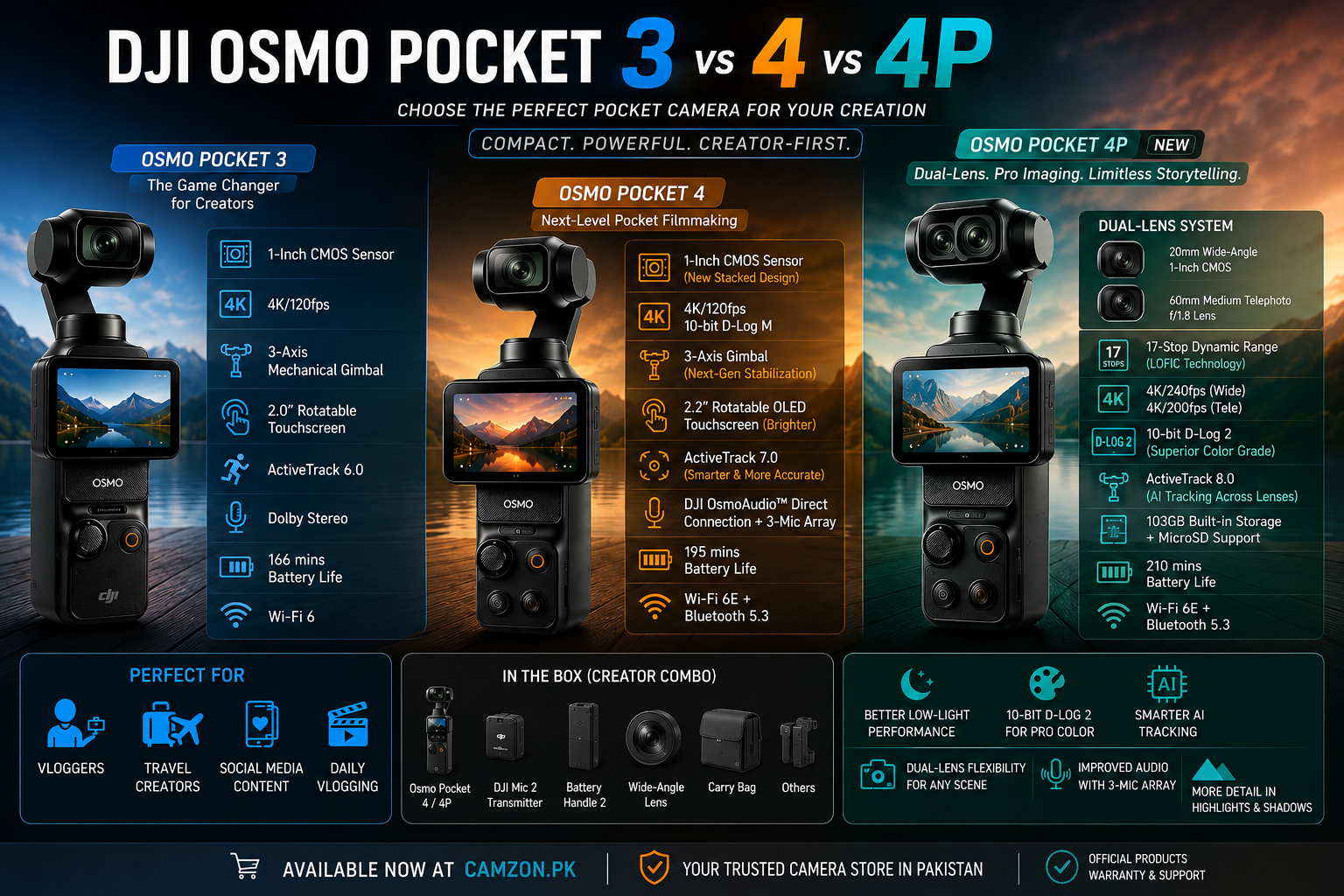
Specifications matter, but the more useful question is what those specifications actually change when you are recording. This quick comparison shows where each model sits in the lineup.
| Feature | Pocket 3 | Pocket 4 | Pocket 4P |
|---|---|---|---|
| Position | Best Value | Best Overall | Premium Creator |
| Main Sensor | 1-inch CMOS | 1-inch CMOS | 1-inch CMOS + second camera |
| Video | Up to 4K/120fps | Up to 4K/240fps | Up to 4K/240fps on wide camera |
| Tracking | ActiveTrack 6.0 | ActiveTrack 7.0 | ActiveTrack 8.0 |
| Dynamic Range | Not officially specified | Up to 14 stops | Up to 17 stops |
| Stabilization | 3-axis mechanical gimbal | 3-axis mechanical gimbal | 3-axis mechanical gimbal |
| Best For | Vlogging & value | Everyday creators | Advanced framing & cinematic work |
Why the DJI Osmo Pocket 4P Is Different
The Pocket 4P should not simply be viewed as a more expensive Pocket 4. Its real advantage is the workflow created by its second physical camera.
The main wide-angle camera is designed for general shooting, while the additional 60mm-equivalent camera gives you a much tighter perspective without relying entirely on digital cropping.
Buy the Pocket 4P for the workflow benefit, not simply because its specification sheet is larger.
For a travel vlogger, the standard Pocket 4 may already provide everything necessary. But for creators producing interviews, product demonstrations, portraits, cinematic B-roll or more controlled commercial work, the second camera can provide a genuinely different shooting option.
If that sounds like your workflow, explore the DJI Osmo Pocket 4P price in Pakistan and current configuration before choosing between the three models.
Why the 60mm Camera on Pocket 4P Matters
A second camera becomes useful when you want a tighter composition without physically moving the camera closer to your subject.
That makes the 60mm perspective especially interesting for portraits, interviews, product videos, talking-head shots and cinematic B-roll.
Instead of treating zoom as simply a number on a specification sheet, think about it as another storytelling perspective. You can establish the environment with the wide camera and then move into a tighter, more isolated composition when the story calls for it.
Image Quality: What Actually Changes?
All three Pocket cameras are designed to deliver strong results in a remarkably small package. The difference becomes more noticeable when you shoot in challenging light, need more room for color grading, or want more control over framing.
The Pocket 4 improves the overall platform with newer imaging and video capabilities, while the Pocket 4P takes the concept further with its second camera and higher-end imaging workflow.
A Gimbal in Your Hand
One of the biggest reasons the Pocket series remains attractive is not simply that it is small. It is that the camera combines portability with a built-in three-axis mechanical gimbal.
For walking videos, travel stories, street content and everyday vlogging, this can dramatically simplify the shooting process.
The real benefit is not only smoother footage. It is the ability to start shooting quickly and concentrate on the story instead of the equipment.
If you want to compare this approach with traditional stabilization, you can also explore Camzon’s gimbals and stabilizers for larger cameras and mobile setups.
Which Pocket Fits Your Creator Workflow?
🎒 Travel & Daily Vlogging
If your priority is portability, fast setup and smooth handheld footage, the Pocket series makes an excellent travel companion. The Pocket 4 is particularly attractive when you want the newest all-round platform.
🎬 YouTube & Social Media
For creators producing regular talking-head videos, reels, travel content and YouTube videos, the Pocket 4 provides a strong balance between capability and simplicity.
For a broader look at creator cameras, see our Best Cameras for YouTube in Pakistan guide.
🎥 Interviews & Product Content
The Pocket 4P becomes more interesting here. Its additional 60mm perspective can give you tighter compositions for people, products and detail shots without changing to a separate camera.
🧳 Travel Creators Who Want Minimal Gear
If carrying a camera body, lens, gimbal and multiple accessories feels excessive, the Pocket concept solves the problem by integrating several important parts of the shooting system into one compact device.
DJI Pocket Camera or Mirrorless Camera?
A Pocket camera and a mirrorless camera solve different problems. A mirrorless system gives you interchangeable lenses, greater expansion potential and broader control over your photography and video workflow.
A Pocket camera gives you something different: speed, portability and integrated stabilization.
If you already own a capable mirrorless camera, the Pocket 4 is better viewed as a complementary grab-and-go camera rather than a universal replacement.
If you are comparing sensor formats and interchangeable-lens systems, our beginner mirrorless camera guide can help explain where a larger camera system makes more sense.
Which DJI Osmo Pocket Should You Buy?
| Your Priority | Recommended Model | Why |
|---|---|---|
| Best value | Pocket 3 | Excellent image quality, stabilization and creator usability. |
| Best overall | Pocket 4 | Best balance of new-generation performance, tracking and portability. |
| Advanced creator workflow | Pocket 4P | Dual-lens flexibility and advanced imaging capabilities. |
| Portrait / tighter framing | Pocket 4P | The additional 60mm perspective adds a genuinely different framing option. |
| Simple travel camera | Pocket 4 | Compact, stabilized and ready to shoot with minimal equipment. |
For most creators, the Pocket 4 offers the best balance of performance, portability and simplicity. The 4P makes more sense when its second camera and advanced imaging workflow solve a specific shooting need.
DJI Osmo Pocket Price in Pakistan
Camera prices in Pakistan can change with exchange rates, import costs, stock availability and bundle configuration. For that reason, it is better to check the current product listing rather than relying on an old comparison price.
Always check the available bundle before ordering because a standard, creator or accessory-focused package can change the overall value of the purchase significantly.
Complete Your Pocket Creator Setup
The camera is only one part of a good production workflow. For talking videos and interviews, audio quality can make a bigger difference than another camera upgrade.
Consider pairing your Pocket setup with a dedicated creator microphone when your content depends heavily on speech.
For example, a compact wireless system such as the DJI Mic 3 can provide a more flexible audio workflow for mobile creators, interviews and vlogging.
You can also browse memory cards and storage for longer recording sessions and tripods and support equipment for static shooting.
Final Thoughts: Buy for Your Workflow, Not the Price Tag
The DJI Osmo Pocket 3, Pocket 4 and Pocket 4P are not simply three generations where the newest model automatically makes everything else obsolete.
The Pocket 3 remains an excellent value proposition. The Pocket 4 is arguably the easiest model to recommend to the broadest range of creators because it balances performance, portability and simplicity. The Pocket 4P is the specialist choice for creators who can take advantage of its dual-camera workflow.
So don’t automatically choose the most expensive Pocket. Choose the model that removes the biggest limitation in your current workflow.
- Best Value → DJI Osmo Pocket 3
- Best Overall → DJI Osmo Pocket 4
- Best Advanced Creator Camera → DJI Osmo Pocket 4P
- Best Dual-Lens Flexibility → DJI Osmo Pocket 4P
Frequently Asked Questions
Is DJI Osmo Pocket 4 worth upgrading from Pocket 3?
It depends on your workflow. If Pocket 3 already gives you the image quality, stabilization and recording features you need, an upgrade is not automatically necessary. Pocket 4 becomes more attractive when its newer tracking, recording and imaging capabilities solve a limitation in your current workflow.
Which DJI Osmo Pocket is best for vlogging?
The Pocket 4 is the strongest all-round recommendation for creators who want a current compact vlogging camera. Pocket 3 remains an excellent value option, while Pocket 4P is better suited to creators who specifically need its dual-camera flexibility.
What is the DJI Osmo Pocket 4 price in Pakistan?
Pricing can change with availability, exchange rates and bundle configuration. Check the current DJI Osmo Pocket 4 listing at Camzon.pk for the latest available price and variants.
What is the DJI Osmo Pocket 4P price in Pakistan?
The Pocket 4P sits in a higher product tier because of its dual-camera concept and advanced imaging workflow. For the latest availability and current pricing, see the DJI Osmo Pocket 4P product page .
Is Pocket 4P better than Pocket 4?
Not for every creator. Pocket 4P is better when its second camera, tighter 60mm perspective and advanced imaging workflow are useful to your work. For general vlogging and everyday creator use, Pocket 4 may offer the better balance.
Is DJI Osmo Pocket better than a mirrorless camera?
They serve different purposes. A mirrorless camera offers interchangeable lenses and a larger expandable system, while Pocket cameras prioritize portability, integrated stabilization and rapid shooting. Many creators can benefit from using both.
Which Pocket camera is best for YouTube?
For most YouTubers, Pocket 4 provides a strong combination of image quality, stabilization, tracking and portability. Pocket 3 is attractive for value-focused creators, while Pocket 4P is particularly interesting for creators producing interviews, product content and more controlled cinematic work.
Can I use a wireless microphone with DJI Osmo Pocket cameras?
Yes, compatible wireless microphone systems can significantly improve spoken-word recording. For creators building a more professional setup, explore Camzon’s audio and wireless microphone collection .
Start with the camera that fits your actual shooting style: Pocket 3 for value , Pocket 4 for the best overall balance , or Pocket 4P for advanced dual-lens flexibility .