





5 Best Full Frame Mirrorless Cameras in 2026 for Professionals & Creators
Full-frame mirrorless cameras represent the highest tier of modern photography technology. Their larger sensors deliver superior low-light performance, wider dynamic range, improved subject separation, and exceptional image quality that professionals rely on for demanding work.
Whether you shoot weddings, wildlife, commercial campaigns, documentaries, YouTube content, sports, or cinematic productions, investing in a full-frame mirrorless system provides both performance and long-term flexibility.
In this guide, we explore five of the best full-frame mirrorless cameras available in 2026, covering flagship hybrid cameras, high-resolution specialists, and value-focused workhorses designed for different budgets and creative needs.
Quick Picks — Best Full Frame Mirrorless Cameras at a Glance
| Need | Best Choice |
|---|---|
| Best Overall | Nikon Z8 |
| Best Value | Nikon Z6 III |
| Best for Video | Canon EOS R5 Mark II |
| Best for Resolution | Sony A7R V |
| Best Hybrid Camera | Sony A7 IV |
Why Choose a Full-Frame Mirrorless Camera?
Full-frame sensors are physically larger than APS-C sensors, allowing them to collect more light and produce cleaner images in challenging conditions.
This results in better low-light performance, improved dynamic range, smoother tonal transitions, and greater control over depth of field. Portrait photographers benefit from creamier background blur, while landscape photographers gain additional shadow and highlight detail.
Full-frame systems also receive the strongest manufacturer support, access to premium lenses, longer firmware support cycles, and generally hold their resale value better than entry-level camera systems.
For creators planning to build a professional ecosystem over many years, full-frame remains the preferred platform.
How to Choose a Full-Frame Mirrorless Camera
Choosing the right full-frame camera depends far more on your shooting style than on specifications alone.
Photographers shooting sports and wildlife should prioritize autofocus speed, burst shooting performance, and subject tracking capabilities. Landscape and commercial photographers may value sensor resolution and dynamic range more highly, while filmmakers often focus on internal RAW recording, frame rates, codecs, and heat management.
Lens availability is equally important. Sony currently offers the largest ecosystem of native and third-party lenses, while Canon and Nikon continue to rapidly expand their RF and Z mount systems.
Professional users should also consider practical factors such as dual memory card slots, weather sealing, battery life, official warranty support, firmware updates, repair availability, and long-term system growth.
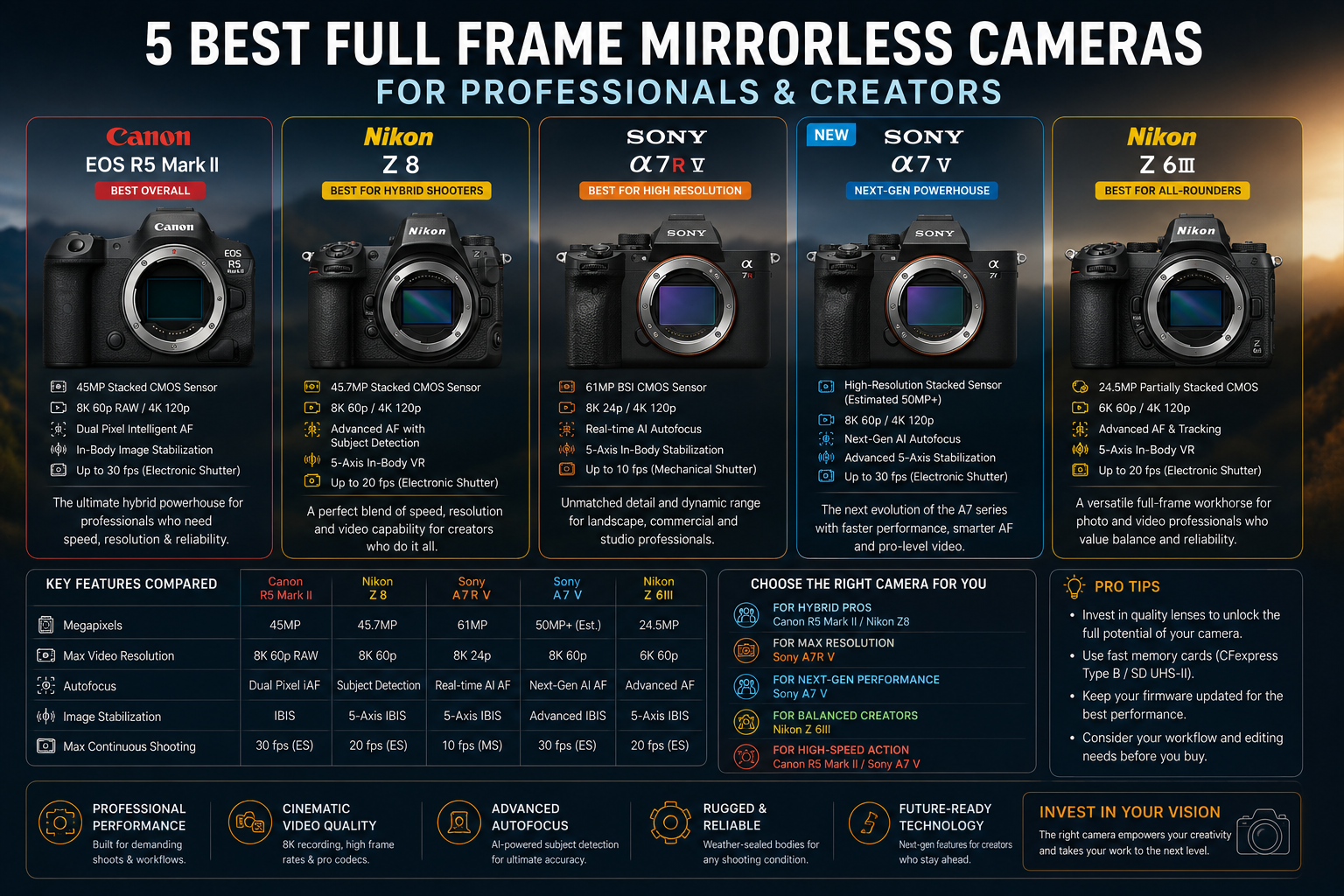
1. Nikon Z8 — Best Overall Full-Frame Mirrorless Camera
The Nikon Z8 is widely considered one of the most capable hybrid cameras currently available. It effectively delivers flagship-level performance inherited from the Nikon Z9 while reducing size, weight, and cost.
Built around a 45.7MP stacked CMOS sensor, the camera delivers exceptional image quality while maintaining impressive speed. Continuous shooting reaches 20 frames per second in RAW format and can climb to an incredible 120 frames per second in JPEG mode for specialized applications.
Video creators benefit from internal 8K 60p RAW recording, advanced codecs, and professional monitoring tools that make the Z8 equally comfortable on commercial film sets and wildlife expeditions.
Removing the mechanical shutter entirely also reduces wear and allows completely silent shooting.
Sensor: 45.7MP Stacked CMOS
Burst Speed: 20 fps RAW / 120 fps JPEG
Video: 8K 60p Internal RAW
Best For: Wildlife, sports, commercial work, documentary filmmaking, hybrid creators.
2. Canon EOS R5 Mark II — Best High-End Hybrid Camera
The Canon EOS R5 Mark II refines one of the most successful professional camera platforms of recent years and introduces major advances in autofocus intelligence and shooting speed.
Its 45MP stacked sensor combines exceptional image quality with electronic shutter speeds reaching 30 frames per second while maintaining full autofocus tracking.
Canon’s latest AI algorithms dramatically improve subject recognition performance, while the next-generation Eye Control Autofocus system allows photographers to move focus points simply by looking at their subjects through the electronic viewfinder.
Video performance is equally impressive thanks to internal 8K 60p RAW recording and 4K 120p capture for cinematic slow-motion production.
Sensor: 45MP Stacked CMOS
Burst Speed: 30 fps Electronic
Video: 8K 60p RAW / 4K 120p
Best For: Sports, weddings, commercial photography, events, hybrid workflows.
3. Sony A7R V — Best for Landscapes and Maximum Detail
For photographers where image detail takes priority over outright speed, the Sony A7R V remains one of the most impressive cameras ever produced.
Its extraordinary 61MP sensor captures exceptional detail and allows aggressive cropping without sacrificing image quality, making it ideal for landscapes, studio photography, architecture, product photography, and large commercial prints.
Sony’s dedicated AI processing unit further enhances autofocus performance by improving human pose estimation and subject recognition for animals, vehicles, and wildlife.
The camera’s unique four-axis multi-angle screen also provides additional flexibility for difficult shooting positions.
Sensor: 61MP Exmor R BSI CMOS
Burst Speed: 10 fps
Video: 8K 24p / 4K 60p
Best For: Landscape, architecture, studio work, fashion, product photography.
4. Sony A7 IV — Best Mid-Range Hybrid Camera
Equipped with a 33MP back-side illuminated sensor, the Sony A7 IV strikes an excellent balance between resolution, speed, low-light performance, and affordability.
Its image quality comfortably exceeds that of many entry-level full-frame systems while maintaining strong video specifications for creators who regularly switch between photography and filmmaking.
One of the A7 IV’s greatest strengths is access to Sony’s enormous E-mount lens ecosystem, which includes premium Sony optics alongside third-party options from Sigma, Tamron, Samyang, and Viltrox.
This flexibility makes the system particularly attractive for wedding photographers, event shooters, YouTube creators, and independent filmmakers.
Sensor: 33MP BSI CMOS
Burst Speed: 10 fps
Video: 4K 60p (crop) / 4K 30p oversampled from 7K
Best For: Weddings, content creation, events, travel, YouTube production.
5. Nikon Z6 III — Best Value Professional Camera
The Nikon Z6 III has quickly become one of the most exciting releases in the full-frame market.
Its partially stacked sensor technology brings many flagship-level capabilities to a significantly lower price point, creating one of the strongest value propositions available to professionals and enthusiasts alike.
Autofocus performance borrows heavily from Nikon’s flagship cameras, while internal 6K RAW recording makes the camera exceptionally attractive for videographers.
The bright electronic viewfinder and excellent low-light performance further strengthen its appeal for wedding photographers and event professionals.
Sensor: 24.5MP Partially Stacked CMOS
Burst Speed: 20 fps RAW / 60 fps JPEG
Video: 6K 60p RAW / 4K 120p
Best For: Low-light photography, weddings, events, videography, hybrid creators.
Best Full Frame Camera by Use Case
| Use Case | Recommended Camera |
|---|---|
| Wildlife Photography | Nikon Z8 |
| Sports Photography | Canon EOS R5 Mark II |
| Weddings | Nikon Z6 III |
| Landscape Photography | Sony A7R V |
| Travel Photography | Sony A7 IV |
| YouTube & Content Creation | Sony A7 IV |
| Commercial Video Production | Nikon Z8 |
| Studio Photography | Sony A7R V |
| Best Overall Value | Nikon Z6 III |
Direct Comparison Overview
| Camera | Resolution | Burst Speed | Video Capability | Best Use Case |
|---|---|---|---|---|
| Nikon Z8 | 45.7MP | 20fps RAW / 120fps JPEG | 8K 60p RAW | Wildlife & Hybrid |
| Canon EOS R5 Mark II | 45MP | 30fps | 8K 60p RAW | Sports & Commercial |
| Sony A7R V | 61MP | 10fps | 8K 24p | Landscape & Studio |
| Sony A7 IV | 33MP | 10fps | 4K 60p | Weddings & Content |
| Nikon Z6 III | 24.5MP | 20fps RAW | 6K 60p RAW | Low Light & Video |
Frequently Asked Questions
Which full-frame mirrorless camera is best for beginners?
The Sony A7 IV and Nikon Z6 III are excellent starting points because they balance professional performance with more accessible pricing and manageable file sizes.
Is full frame worth the extra money?
For professionals and serious enthusiasts, full-frame cameras often justify their higher price through better low-light performance, improved dynamic range, stronger lens ecosystems, and higher resale value.
Nikon or Sony for professionals?
Both systems are excellent. Sony offers the largest lens ecosystem, while Nikon has become extremely competitive with its recent Z-series cameras and autofocus improvements.
Canon or Nikon for wildlife photography?
The Nikon Z8 and Canon EOS R5 Mark II are currently among the strongest wildlife cameras available, with both offering exceptional subject tracking and burst shooting performance.
Which full-frame camera has the best autofocus?
The Nikon Z8, Canon EOS R5 Mark II, and Sony A7R V all offer autofocus systems that rank among the best currently available.
Which camera is best for filmmaking?
For professional video production, the Nikon Z8 and Canon EOS R5 Mark II stand out thanks to their internal RAW recording capabilities and advanced video features.
Final Thoughts
Choosing the best full-frame mirrorless camera is not simply about buying the most expensive body or the camera with the highest resolution. The right choice depends on the type of photography or filmmaking you plan to pursue, the lenses you intend to use, your workflow requirements, and the long-term system you want to build.
Wildlife and sports photographers often prioritize autofocus speed, subject tracking accuracy, and high burst shooting performance, making cameras such as the Nikon Z8 and Canon EOS R5 Mark II particularly attractive options. Landscape, architecture, and commercial photographers may place greater importance on resolution and dynamic range, where the Sony A7R V continues to excel. Wedding photographers, event shooters, and hybrid creators frequently seek the balance of image quality, video capabilities, and affordability offered by cameras such as the Sony A7 IV and Nikon Z6 III.
For buyers still deciding whether a full-frame system is the right investment, our guides on APS-C vs Full Frame Cameras and DSLR vs Mirrorless Cameras provide valuable insight into sensor sizes, system advantages, and long-term upgrade paths. Creators entering the video space may also benefit from our Best Vlogging Cameras in Pakistan guide and our beginner-focused Mirrorless Camera Buying Guide.
A professional camera body is only one part of a complete photography ecosystem. Lens selection often has a greater impact on image quality and creative possibilities than the camera itself. Depending on your chosen system, you may also want to explore our guides covering Canon RF Lenses, Sony E-Mount Lenses, and Nikon Z Lenses when building your kit.
Storage and workflow are equally important considerations for modern high-resolution cameras. Many of today’s professional bodies generate enormous RAW files and high-bitrate 4K, 6K, and even 8K video footage, making reliable storage essential. Our Memory Cards Buying Guide can help you choose the right SD or CFexpress cards for high-speed shooting and professional video recording.
Creators focused on filmmaking should also consider supporting accessories that unlock the full potential of their camera system. Our articles on camera gimbals, video lights, wireless microphones, tripods, and camera bags can help you build a complete production setup for weddings, documentaries, YouTube content, commercial projects, and travel filmmaking.
Full-frame mirrorless cameras are rarely standalone purchases. The greatest value comes from investing in a complete system of lenses, accessories, storage solutions, and support equipment that can continue growing alongside your skills and creative ambitions for years to come.
Whether you are capturing wildlife in challenging conditions, producing cinematic films, shooting commercial campaigns, or documenting life’s important moments, choosing the right full-frame mirrorless ecosystem today can serve as the foundation of your creative work for the next decade.