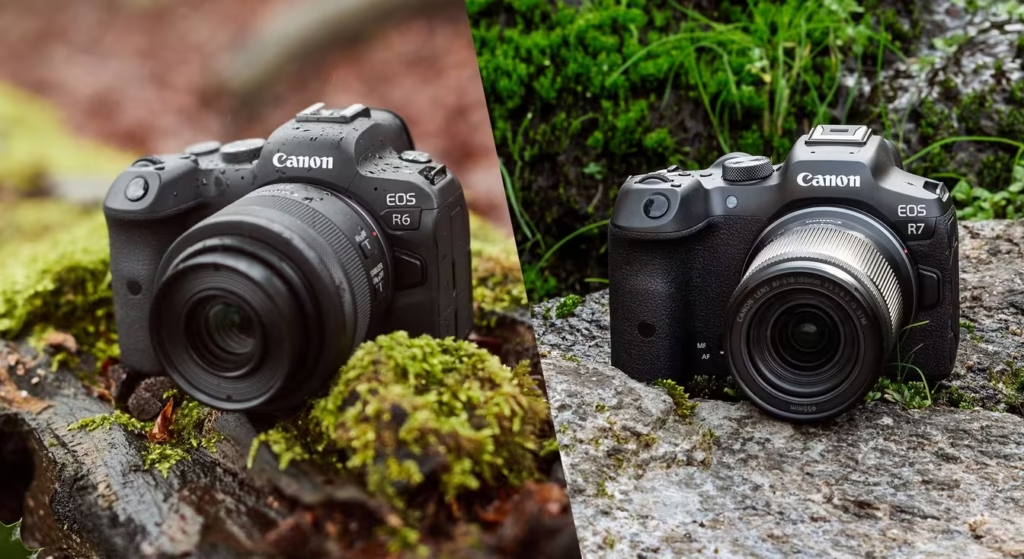






APS-C vs Full Frame Cameras: What’s the Difference?
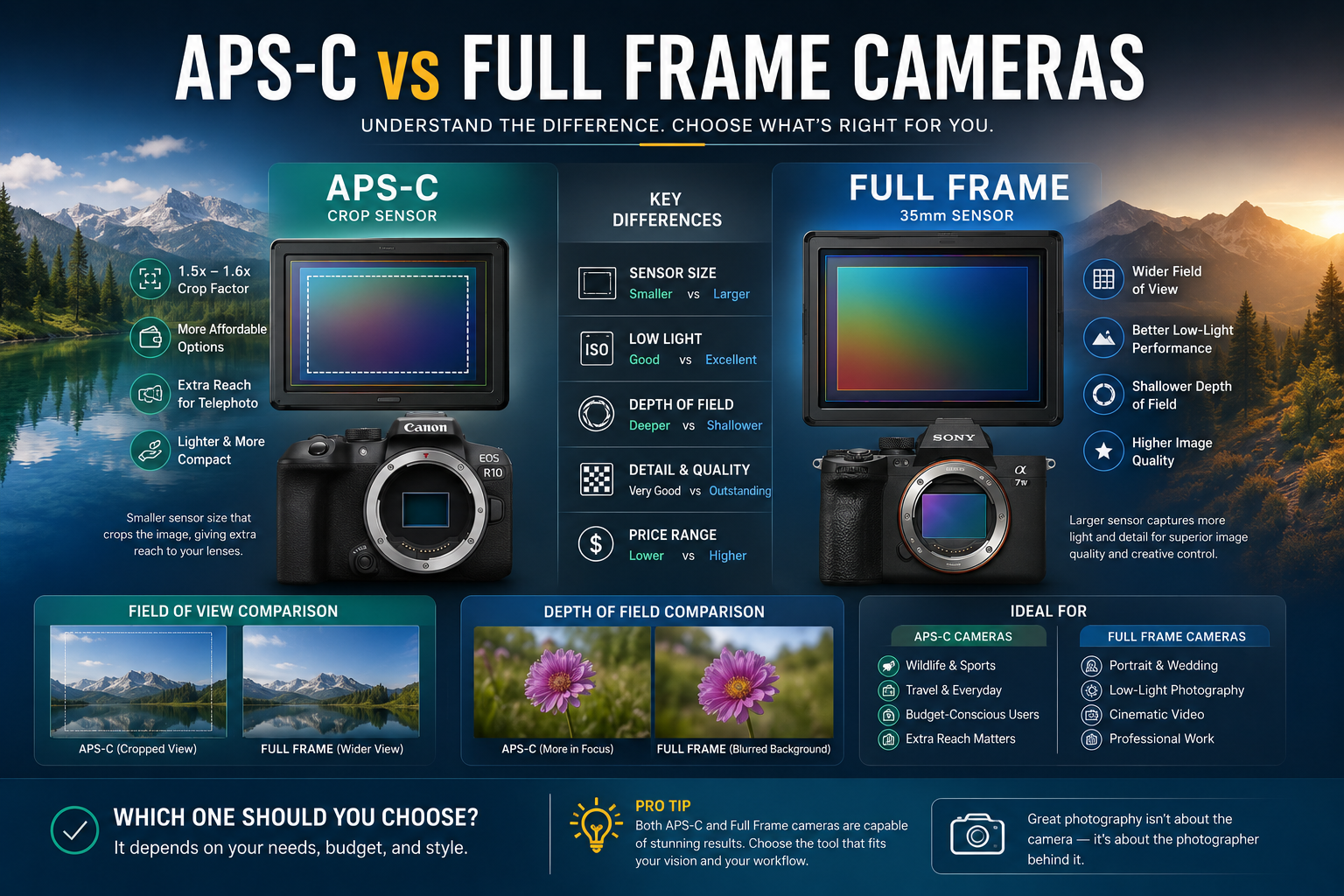
Choosing between an APS-C camera and a full-frame camera is one of the most important decisions when building a camera system. Sensor size affects image quality, low-light performance, dynamic range, depth of field, lens selection, portability and overall system cost.
APS-C vs Full Frame Cameras – Which Should You Buy?
A practical guide for photographers, vloggers and filmmakers.
Whether you are buying your first camera in Pakistan, starting a YouTube channel, photographing weddings, shooting wildlife or upgrading to professional equipment, understanding the difference between APS-C and full-frame cameras can help you make a better long-term investment.
Neither sensor format is universally better. APS-C cameras can offer excellent image quality, lower system costs and greater portability, while full-frame cameras provide advantages in areas such as low-light performance, dynamic range and depth-of-field control.
APS-C vs Full Frame Cameras at a Glance
Quick comparison of the major differences.
| Feature | APS-C Camera | Full Frame Camera |
|---|---|---|
| Sensor Size | Smaller | Larger |
| Typical Dimensions | Approximately 23.5 × 15.6 mm | Approximately 36 × 24 mm |
| Image Quality | Excellent | Excellent to outstanding |
| Dynamic Range | Very Good | Generally excellent |
| Low-Light Performance | Very Good | Generally better |
| Background Blur | Very Good | Greater potential |
| Crop Factor | Approximately 1.5×–1.6× | 1× |
| Camera Cost | Generally lower | Generally higher |
| Lens Cost | Often lower | Often higher |
| Portability | Excellent | Good to excellent |
| Wildlife | Excellent | Excellent |
| Landscape | Excellent | Excellent |
| Beginner Friendly | Excellent | Good |
| Professional Work | Excellent | Excellent |
What Is an APS-C Camera?
Smaller sensors with excellent performance and portability.
An APS-C camera uses a sensor smaller than full frame. Depending on the manufacturer, APS-C systems typically use approximately a 1.5× or 1.6× crop factor.
The crop factor does not physically change the focal length of a lens. Instead, the smaller sensor captures a narrower portion of the lens’s image circle, producing a field of view that appears more zoomed in compared with full frame.
For example, a 50mm lens on a Sony APS-C camera provides a field of view comparable to approximately 75mm on full frame. On Canon APS-C, the equivalent field of view is approximately 80mm.
This additional reach can be particularly useful for wildlife, birds and sports photography. APS-C systems are also popular among beginners, students, travel photographers, vloggers and content creators because the bodies and lenses can be smaller, lighter and less expensive.
Canon EOS R50
The Canon EOS R50 is a compact APS-C mirrorless camera suitable for beginners, travel photography and content creation.
Canon EOS R50 V
The EOS R50 V is designed with content creators and video production in mind, making it an interesting option for YouTube and vlogging workflows.
Sony A6700
A powerful APS-C mirrorless camera with advanced autofocus and strong video capabilities.
Nikon Z50 II
A compact APS-C Nikon mirrorless camera suitable for photography and content creation.
Fujifilm X-S20
A versatile APS-C camera that combines portability, photography and video capabilities.
What Is a Full Frame Camera?
Larger sensors for demanding photography and video workflows.
A full-frame camera uses a sensor approximately equivalent to the size of traditional 35mm film, measuring about 36 × 24 mm.
The larger sensor provides more surface area for collecting light. Depending on the camera design and sensor generation, this can contribute to cleaner high-ISO performance, stronger dynamic range and greater control over depth of field.
These characteristics make full-frame cameras particularly attractive for portrait photography, weddings, commercial photography, filmmaking and professional content creation.
Sony A7 IV
A versatile full-frame mirrorless camera suitable for photography and hybrid content creation.
Canon EOS R8
A lightweight full-frame Canon mirrorless camera designed for hybrid photography and video.
Canon EOS R5 Mark II
A high-end full-frame mirrorless platform aimed at demanding professional photography and video.
Nikon Z6 II
A full-frame Nikon mirrorless option for photographers and hybrid shooters.
APS-C vs Full Frame Sensor Size
The physical difference between the two sensor formats.
APS-C sensors typically measure around 23.5 × 15.6 mm, although exact dimensions vary slightly between manufacturers.
Canon APS-C cameras generally use a 1.6× crop factor, while Sony, Nikon and Fujifilm APS-C systems generally use a 1.5× crop factor.
Full-frame sensors measure approximately 36 × 24 mm and have substantially more surface area than APS-C sensors.
APS-C vs Full Frame Image Quality
How much difference does sensor size actually make?
Modern APS-C cameras can produce exceptional image quality and are more than capable of professional photography, YouTube production, commercial projects and large prints.
Full-frame cameras generally provide additional performance potential because the larger sensor can collect more light under comparable conditions.
The difference becomes more noticeable when recovering shadows, preserving highlights, shooting at high ISO settings or performing extensive RAW processing.
Dynamic Range
Preserving detail in highlights and shadows.
Dynamic range describes a camera’s ability to record detail across very bright and very dark areas of a scene.
Full-frame cameras can offer an advantage in demanding situations such as landscapes, sunrise and sunset photography, weddings, architecture and commercial work.
Photographers who regularly edit RAW files may appreciate additional flexibility when recovering shadow and highlight information.
However, modern APS-C sensors have improved considerably and provide excellent dynamic range for most everyday photography and content creation.
Low-Light Performance
One of the areas where full frame can have a practical advantage.
Low-light performance is one of the major reasons professional photographers consider full-frame cameras.
The larger sensor can provide an advantage in demanding lighting conditions, helping photographers achieve cleaner results at high ISO settings when comparing systems with similar technology and exposure conditions.
This can be particularly valuable for weddings, concerts, indoor events and night photography.
APS-C cameras still perform extremely well in daylight, controlled lighting and many everyday shooting situations. Modern sensor technology has also narrowed the practical gap.
Depth of Field and Background Blur
Understanding bokeh and subject separation.
Full-frame cameras can make it easier to achieve shallow depth of field and strong background separation when maintaining equivalent framing and aperture conditions.
This is one reason full-frame systems are popular for portraits, weddings and cinematic filmmaking.
APS-C cameras can still produce excellent background blur, particularly when paired with fast lenses such as 35mm f/1.4, 50mm f/1.8 or 56mm f/1.4 lenses.
Crop Factor and Field of View
Why APS-C can be particularly useful for wildlife and sports.
APS-C’s smaller sensor captures a narrower portion of the lens’s image circle, producing a narrower field of view.
| Lens | Sony / Nikon / Fujifilm APS-C | Canon APS-C |
|---|---|---|
| 50mm | Approximately 75mm equivalent | Approximately 80mm equivalent |
| 200mm | Approximately 300mm equivalent | Approximately 320mm equivalent |
This can be valuable for wildlife, bird and sports photographers who want greater effective reach without immediately moving to a longer and more expensive telephoto lens.
APS-C vs Full Frame for Video
Both formats can be excellent for YouTube and professional video.
Modern APS-C cameras offer impressive video capabilities, advanced autofocus and compact bodies that are highly attractive to YouTubers, vloggers and travel creators.
Sony A6700
A powerful APS-C hybrid camera with advanced autofocus and strong video capabilities.
Sony FX3
A full-frame cinema-oriented camera for demanding professional video workflows.
Full-frame cameras can provide advantages in low light, background separation and certain cinematic workflows, but APS-C remains an excellent choice for the majority of YouTube and content-creation applications.
Burst Shooting and Battery Life
Sensor size does not determine every aspect of camera performance.
Burst shooting speed depends primarily on the processor, mechanical or electronic shutter design, buffer capacity, autofocus system and storage media rather than sensor size alone.
Similarly, battery life depends heavily on camera design, display usage, video recording, autofocus and wireless connectivity.
Therefore, it is incorrect to assume that every full-frame camera will automatically be faster or have better battery life than every APS-C camera.
Lens Ecosystem and Overall System Cost
The camera body is only one part of your investment.
One of the biggest advantages of APS-C systems is the availability of smaller and often more affordable lenses.
Brands such as Sigma, Tamron, Viltrox and other manufacturers provide a wide selection of APS-C lenses for different camera mounts.
Full-frame systems offer access to premium lenses with exceptional optical performance, but these lenses can be larger, heavier and more expensive.
Portability and Travel Photography
Smaller systems can be a major advantage when you travel frequently.
APS-C cameras are typically smaller and lighter than comparable full-frame systems, although the exact difference depends on the camera body and lens combination.
Travel photographers, vloggers, students and content creators often prefer APS-C because it provides excellent image quality without requiring a large kit.
Modern full-frame mirrorless cameras have also become considerably smaller, so portability should always be judged by the complete camera-and-lens system rather than the camera body alone.
Who Should Buy APS-C vs Full Frame Cameras?
Choose the format according to your actual shooting needs.
Choose APS-C If You Are…
A beginner, student, hobbyist, travel photographer, wildlife photographer, YouTuber, vlogger or budget-conscious creator looking for strong performance in a compact system.
Choose Full Frame If You Are…
A professional photographer or filmmaker who regularly needs strong low-light performance, high dynamic range, shallow depth of field or advanced professional features.
Hybrid Creator?
If you photograph and record video, compare autofocus, video formats, stabilization, lens selection and workflow features rather than sensor size alone.
Practical Camera Buying Advice from Camzon
Start with your workflow, then choose your sensor format.
At Camzon, many first-time buyers assume that a full-frame camera is automatically the better investment.
In reality, many beginners are better served by a modern APS-C camera because it offers excellent image quality, lower overall system cost and lighter equipment.
The money saved can instead be invested in better lenses, memory cards, lighting equipment, microphones, tripods and other accessories that directly improve the overall production workflow.
Frequently Asked Questions About APS-C vs Full Frame Cameras
Quick answers before choosing your next camera system.
Is APS-C better than Full Frame?
Neither format is universally better. APS-C offers excellent portability and value, while full frame provides advantages in areas such as low-light performance, dynamic range and depth-of-field control.
Is Full Frame worth the extra money?
For professionals working in weddings, commercial photography, filmmaking and demanding low-light environments, the additional investment can be worthwhile. Beginners may get better overall value from APS-C.
Can APS-C cameras produce professional images?
Yes. Modern APS-C cameras are capable of producing professional-quality photographs and video for commercial work, YouTube, social media and many other applications.
Is APS-C enough for YouTube?
Absolutely. APS-C cameras can provide excellent autofocus, video quality and portability for YouTube and content creation.
Is APS-C better for wildlife photography?
APS-C can be advantageous for wildlife because its crop factor provides a narrower field of view, effectively giving telephoto lenses greater reach in terms of framing.
Should beginners buy Full Frame?
Beginners can certainly use full frame, but APS-C often provides better value because the camera and lens system can be smaller and more affordable.
Final Thoughts: APS-C vs Full Frame Cameras
The right sensor is the one that fits your photography and video workflow.
The APS-C vs Full Frame Cameras debate is not simply about which sensor is better. It is about which format best matches your shooting style, budget, portability requirements and long-term goals.
For beginners, students, travel photographers and many content creators, APS-C remains one of the smartest camera-system investments because it combines excellent image quality with relatively compact bodies and lenses.
For professionals working in demanding commercial environments, weddings, portrait photography, filmmaking and low-light situations, full-frame cameras can provide meaningful advantages in image quality, dynamic range and depth-of-field control.
Ultimately, the best camera is not necessarily the one with the largest sensor. It is the camera system that gives you the features, lenses, portability and performance you actually need.
Still Deciding Between APS-C and Full Frame?
Explore Camzon’s camera buying guides and compare actual camera models before making your investment.