





.
DSLR vs Mirrorless Cameras: 10 Key Differences Every Buyer Should Know in Pakistan
Choosing between a DSLR and mirrorless camera is one of the biggest decisions photographers, videographers and content creators face when buying an interchangeable-lens camera.Both systems can produce outstanding images, but their technology, handling, autofocus, video capabilities and long-term system direction are very different.
DSLR vs Mirrorless Cameras: Which Is Better?
A practical comparison for photographers and creators in Pakistan.
For years, DSLR cameras dominated interchangeable-lens photography because of their optical viewfinders, excellent battery life and mature lens ecosystems.
Today, mirrorless cameras have become the main development focus of almost every major camera manufacturer. Faster autofocus, electronic viewfinders, advanced subject recognition, high-speed burst shooting, in-body stabilization and powerful video features have made mirrorless systems increasingly attractive to modern photographers and creators.
However, that does not mean every photographer needs to replace a DSLR. The right choice depends on your budget, photography style, video requirements, lens collection and long-term plans.
DSLR vs Mirrorless Cameras: Quick Comparison
The most important differences at a glance.
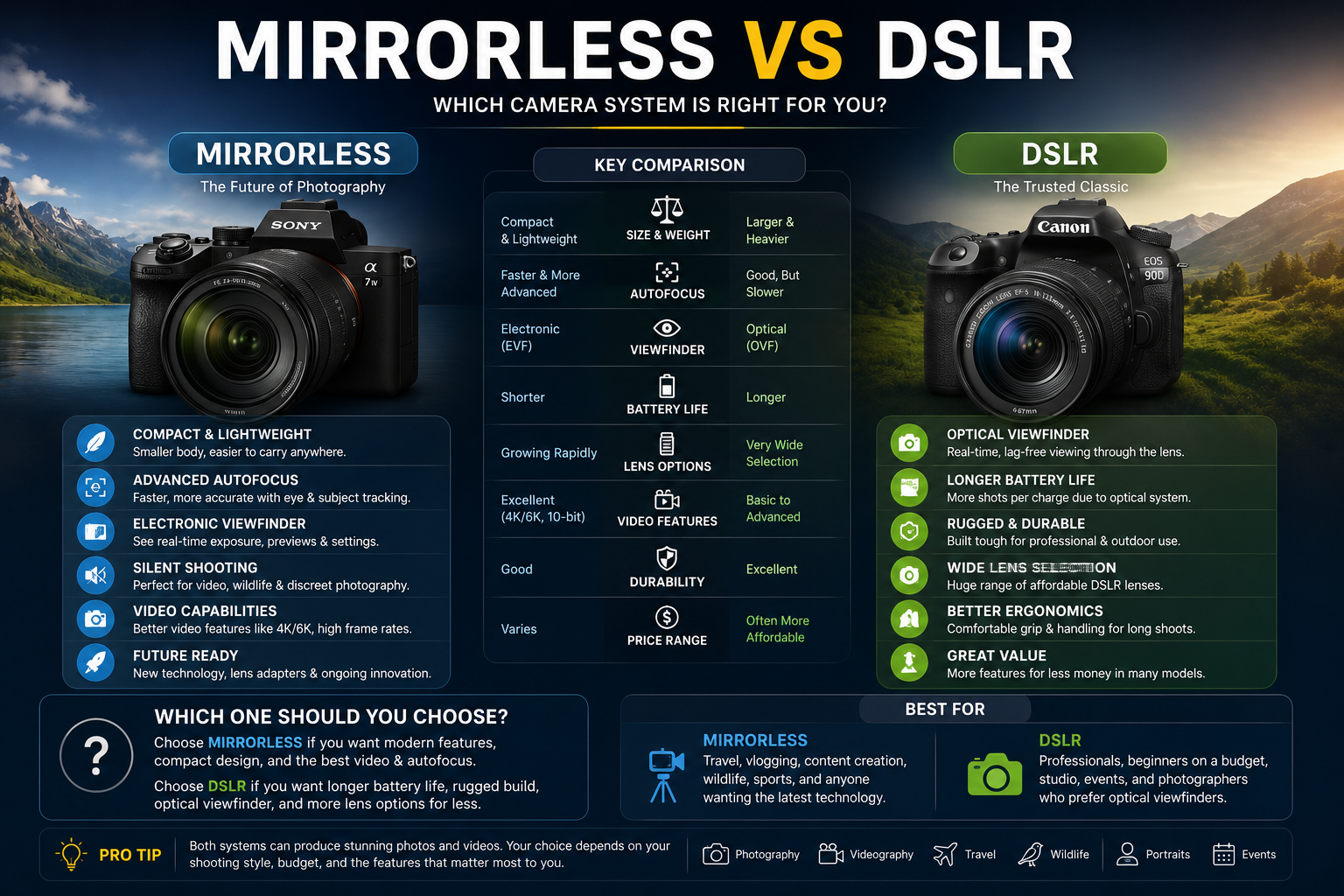
| Feature | DSLR Cameras | Mirrorless Cameras |
|---|---|---|
| Viewfinder | Optical Viewfinder (OVF) | Electronic Viewfinder (EVF), where fitted |
| Body Size | Generally larger | Generally more compact |
| Battery Life | Generally excellent | Generally lower, but improving |
| Autofocus | Excellent on many models | Advanced subject tracking on many modern models |
| Burst Shooting | Typically lower | Often significantly faster |
| Video | Good to very good depending on model | Generally stronger for modern hybrid workflows |
| Silent Shooting | Limited | Available on many models |
| IBIS | Rare | Common on many advanced models |
| Lens Market | Huge mature used market | Rapidly expanding modern ecosystem |
| Future Development | Limited new development | Main industry development direction |
DSLR vs Mirrorless Cameras: How Do They Work?
The fundamental difference is the presence or absence of a mirror.
A DSLR, or Digital Single-Lens Reflex camera, uses a mirror positioned between the lens and the image sensor. Light entering through the lens is reflected upward into the optical viewfinder, allowing the photographer to see the scene directly through the lens.
When the shutter is released, the mirror moves out of the way so that light can reach the image sensor and record the photograph.
A mirrorless camera removes this mirror mechanism. Light travels directly from the lens to the image sensor, which then provides the live image to the rear screen and, on models equipped with one, the electronic viewfinder.
Eliminating the mirror box allows manufacturers to create different body designs and enables highly integrated electronic autofocus, stabilization and video systems.
1. DSLR vs Mirrorless: Size and Portability
Smaller equipment can make a difference during long shooting sessions.
DSLR bodies require space for the mirror mechanism and optical viewfinder assembly, which generally results in larger bodies.
Mirrorless cameras remove these components, allowing manufacturers to create compact bodies while retaining large sensors and interchangeable lenses.
This can be particularly useful for travel photographers, vloggers, hikers, event photographers and creators who carry their equipment for extended periods.
Winner: Mirrorless2. DSLR vs Mirrorless Lens Mount Technology
Why modern mirrorless mounts are designed for the future.
Mirrorless cameras can use shorter flange distances because they do not need to accommodate a reflex mirror between the lens and image sensor.
This gives manufacturers greater freedom when designing new lenses and can allow sophisticated optical designs with excellent sharpness and performance.
Modern mirrorless systems also use sophisticated electronic communication between the camera and lens, supporting advanced autofocus, stabilization, lens corrections and other features.
DSLR lens ecosystems remain extremely mature, however, with decades of Canon EF, Nikon F, Sony A and other lenses available on the new and used markets.
Winner: Mirrorless for future development3. Optical vs Electronic Viewfinder
Two completely different ways of viewing your subject.
DSLR Optical Viewfinder
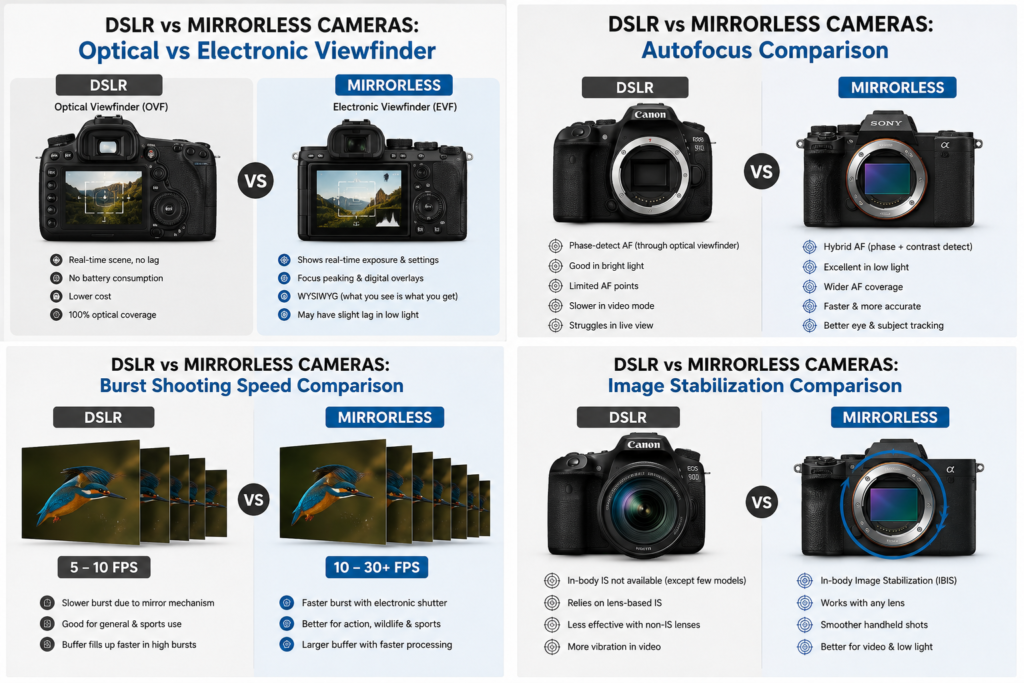
An optical viewfinder allows you to look directly through the lens using the camera’s mirror and prism system. There is no electronic image preview.
Mirrorless Electronic Viewfinder
An electronic viewfinder displays a live feed from the image sensor and can show exposure, white balance, histograms, focus aids and other shooting information.
Exposure Preview
EVFs allow photographers to preview the effect of exposure settings before pressing the shutter, which can reduce guesswork in difficult lighting.
4. DSLR vs Mirrorless Autofocus
Modern subject recognition is one of mirrorless’s biggest advantages.
DSLR cameras can provide excellent autofocus performance, particularly through their optical viewfinders. However, autofocus during live view and video can be more restricted depending on the camera generation.
Modern mirrorless cameras use autofocus information directly from the imaging sensor. This allows manufacturers to place focus detection across a large portion of the frame.
Advanced mirrorless systems can recognize and track subjects such as people, faces, eyes, animals, birds, vehicles and other moving subjects.
This can be particularly valuable for weddings, sports, wildlife, family photography and fast-moving events.
Winner: Mirrorless5. Low-Light Autofocus Performance
A major consideration for weddings, events and night photography.
Modern mirrorless cameras can deliver highly capable autofocus in challenging lighting conditions because focusing is performed using the imaging sensor and advanced processing systems.
This is particularly useful for wedding photographers working in dim venues, event photographers covering evening functions, wildlife photographers shooting around dawn or dusk, and filmmakers working in difficult lighting.
Actual low-light autofocus performance varies considerably between individual camera models, lenses and firmware versions, so buyers should always compare the specifications and real-world performance of the specific cameras they are considering.
Winner: Modern Mirrorless6. Burst Shooting Speed
Faster continuous shooting can help capture decisive moments.
The absence of a moving mirror gives mirrorless cameras an important advantage when using electronic shutters and advanced continuous shooting modes.
Many modern mirrorless cameras can shoot at 20, 30 or even 40 frames per second under certain conditions, while flagship systems can achieve even higher rates in specialized modes.
DSLR cameras can still deliver excellent burst performance, particularly professional models, but mirrorless systems currently dominate the high-speed segment.
Winner: Mirrorless7. Pre-Capture Technology
Capture moments that happen before you fully press the shutter.
Some modern mirrorless cameras can continuously buffer images while the shutter button is partially pressed.
When the shutter is fully pressed, the camera can save frames captured immediately before the final shutter command.
This is particularly useful for unpredictable subjects such as birds taking flight, sports action, wildlife behavior and spontaneous moments.
8. Silent Shooting
Useful when camera noise could distract the subject.
Many mirrorless cameras support fully electronic shutter shooting, which can operate without the sound of a mechanical shutter mechanism.
Silent shooting can be useful during weddings, wildlife photography, conferences, theater performances, documentary work and other situations where discretion matters.
9. DSLR vs Mirrorless Cameras for Video
Mirrorless cameras have become the dominant choice for hybrid creators.
Video is one of the areas where modern mirrorless systems have developed the strongest advantage.
Many current mirrorless cameras offer advanced 4K recording, high frame rates, Log profiles, sophisticated autofocus, articulating screens and powerful image-processing capabilities.
Features such as subject tracking, focus-breathing compensation, improved autofocus motors and hybrid lens designs also make mirrorless cameras particularly attractive to filmmakers, YouTubers and content creators.
Winner: Mirrorless10. Image Stabilization
IBIS can improve handheld photography and video.
Many advanced mirrorless cameras feature In-Body Image Stabilization, or IBIS, which moves the image sensor to compensate for small movements made while shooting handheld.
When compatible lenses also include optical stabilization, the two systems can work together to provide additional stabilization performance.
IBIS can be particularly useful for handheld photography, low-light shooting and video production.
Winner: MirrorlessDSLR vs Mirrorless Battery Life
DSLRs still hold an important advantage for long shooting sessions.
Battery life remains one of the strongest arguments in favor of DSLR cameras.
An optical viewfinder does not require the camera to continuously power an electronic display, allowing many DSLRs to achieve excellent battery endurance.
Mirrorless cameras continuously power electronic viewfinders, LCD screens and sophisticated processing systems. As a result, battery consumption can be higher.
Modern mirrorless cameras have improved substantially, and USB charging and USB power delivery can make extended shooting much easier.
Winner: DSLRDSLR vs Mirrorless Lens Ecosystem
Compare today’s mirrorless development with the mature DSLR market.
DSLR systems have benefited from decades of lens development. Canon EF, Nikon F and other DSLR mounts have huge selections available across professional, enthusiast and budget categories.
The second-hand market is another major advantage. Photographers can often find high-quality DSLR lenses at attractive prices.
Mirrorless lens ecosystems, however, are expanding rapidly. Manufacturers are directing most new optical development toward their current mirrorless mounts.
Lens adapters also allow many DSLR lenses to be used on compatible mirrorless bodies, giving photographers a way to continue using existing equipment while transitioning to a newer system.
Best for Affordability
A mature used market makes DSLR lenses particularly attractive to photographers working with limited budgets.
Best for Future Development
New lens designs and advanced optical technologies are increasingly concentrated around mirrorless mounts.
Adapters Add Flexibility
Compatible adapters can allow photographers to use selected DSLR lenses on newer mirrorless systems.
DSLR vs Mirrorless Image Quality
Sensor and lens quality matter more than the mirror mechanism.
A common misconception is that mirrorless cameras automatically produce better image quality than DSLRs.
In reality, image quality depends primarily on sensor size, sensor technology, lens quality, dynamic range, image processing, lighting and the photographer’s technique.
A DSLR and mirrorless camera with comparable sensors and lenses can produce remarkably similar photographs.
Modern mirrorless systems can nevertheless benefit from close integration between camera bodies and lenses, including sophisticated electronic corrections and advanced processing.
Who Should Buy a DSLR Camera?
DSLRs still make sense for several types of photographers.
Still Photography
Ideal for photographers who primarily shoot photographs and enjoy the traditional optical viewfinder experience.
Budget Buyers
Used DSLR bodies and lenses can offer excellent value for beginners and students.
Long Shooting Sessions
Excellent battery endurance can be valuable for weddings, events and long outdoor sessions.
Who Should Buy a Mirrorless Camera?
The strongest choice for many new hybrid creators.
YouTubers & Vloggers
Advanced autofocus, video features, compact bodies and articulating screens make mirrorless systems highly suitable for content creation.
Wildlife & Sports
Fast burst shooting and sophisticated subject tracking can make modern mirrorless cameras excellent for action.
Hybrid Creators
If photography and video are both important to your workflow, mirrorless cameras offer a powerful combination of features.
Practical Buying Advice from Camzon
Choose the system around your actual workflow, not specifications alone.
If you are buying your first interchangeable-lens camera in Pakistan, it is easy to become focused on specifications such as megapixels, burst rates and sensor size.
A better approach is to consider how you actually shoot. A travel creator may value a lightweight mirrorless body, while an event photographer may prioritize battery life. A wildlife photographer may care most about autofocus and burst performance, while a beginner may benefit most from an affordable camera and a good lens.
Remember that the camera body is only one part of a complete system. Lenses, memory cards, lighting, microphones, tripods and stabilization equipment can all have a major impact on the final production.
DSLR vs Mirrorless Cameras – Frequently Asked Questions
Quick answers for buyers in Pakistan.
Is DSLR better than mirrorless?
Neither system is universally better. DSLRs offer excellent battery life and a mature lens market, while mirrorless cameras generally provide more advanced autofocus, video features, stabilization and compact designs.
Do mirrorless cameras take better pictures?
Not automatically. Image quality depends heavily on sensor technology, sensor size, lens quality, lighting and image processing rather than simply whether the camera has a mirror.
Why are photographers switching to mirrorless cameras?
Common reasons include advanced autofocus, subject tracking, electronic viewfinders, silent shooting, faster burst rates, in-body stabilization and stronger video capabilities.
Can DSLR lenses be used on mirrorless cameras?
Yes. Compatible adapters allow many DSLR lenses to be used on mirrorless bodies. The exact autofocus, stabilization and electronic functionality depends on the lens, adapter and camera combination.
Is mirrorless worth buying in 2026?
For most new buyers, mirrorless is the strongest long-term direction because major manufacturers are concentrating current camera and lens development on mirrorless systems.
Which camera is best for YouTube and content creation?
Mirrorless cameras are generally better suited to modern content creation because of their autofocus, video features, compact designs and compatibility with creator-focused lenses and accessories.
Are DSLR cameras becoming obsolete?
DSLRs are not suddenly unusable or obsolete. They remain capable cameras with excellent image quality. However, new camera development is now overwhelmingly focused on mirrorless systems.
Which camera is better for beginners in Pakistan?
Beginners focused mainly on photography can still find excellent value in DSLRs, particularly on the used market. Beginners interested in both photography and video should strongly consider a modern mirrorless camera.
DSLR vs Mirrorless Cameras: Final Verdict
The right camera depends on your workflow, not simply the technology.
The DSLR versus mirrorless debate is no longer simply about which system is universally better. It is about choosing the camera platform that best matches your photography, video requirements, budget and long-term plans.
DSLRs continue to offer excellent battery life, reliable performance, optical viewfinders and access to a huge mature lens market. For photographers focused primarily on still photography, especially those buying used equipment, DSLRs can still represent excellent value.
Mirrorless cameras, however, have become the primary development platform for most major camera manufacturers. Advanced autofocus, electronic viewfinders, high-speed shooting, silent operation, IBIS and powerful video capabilities make them particularly attractive to modern hybrid creators.
Choose DSLR If…
You prioritize battery life, optical viewfinders, affordable used lenses and traditional still-photography handling.
Choose Mirrorless If…
You want advanced autofocus, video capabilities, stabilization, compact equipment and a system built around current camera development.
For Most New Creators
If you are starting from scratch in 2026 and plan to shoot both photos and video, mirrorless is generally the more future-oriented choice.
Ready to Choose Your Camera?
Compare Camzon’s camera collections and continue with our detailed buying guides before making your next investment.